What is that funky Figure 8 on the sundial?
How can I make the time readings more accurate?
Using the Sundial....as a Compass!
Other sundial links (to come)
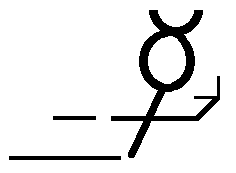
The Earth rotates at a constant speed, taking 23 hours, 56 minutes, 4 seconds to turn once around its axis (okay, it actually does change speeds slightly due to some internal changes, effects of the planets, etc.....these are extremely minute changes over human lifetimes). But we are also moving around the sun in our orbit so when we've turned once around, the sun isn't where it was in the sky when we started. It takes 4 more minutes to catch up. This 24-hour steady noon-to-noon motion is called the motion of the mean sun and its steadiness is the origin of mean solar time, the time of the sundial.
But the real sun's speed across the sky actually varies. The Earth's orbit is elliptical. This non-circular path causes Earth's orbital speed to increase or decrease over the course of a year. When we are nearer the sun we move faster in our orbit, when farther out than our average 92.9 million miles, we move slower. This in turn causes our sun's apparent position to be "fast" or "slow" (i.e. it gets due south some minutes sooner or later than usual). Thus the apparent solar time can vary from that steady digital watch or sundial time by as much as about 16 minutes. One could add or subtract the values (known as the values of the Equation of Time) to the sundial time to get the correct time or simply adjust the position of the gnomon on the sundial by shifting its place left or right for the appropriate months. On the Hermograph sundial shirt, we do the latter.
However, the sun's position also changes during the year in a vertical way, because of the tilt of the Earth's axis. It is higher in northern summers, lower in northern winters. The sun sets early in winter, say at 4:30PM, while it can be up past 8PM in summer. The gnomon shadow should be horizontal at sunrise or sunset but if we didn't adjust the gnomon's position on this dial it would record the same sunrise and sunset times for all 12 months, and that clearly isn't the way it is in nature. So the analemma not only adjusts for the changing speeds of the Earth in its orbit but also adjusts the gnomon's position on the dial to account for its changing seasonal north-south altitudes (height in the sky). A 4PM shadow reading should be 4PM no matter what season it is.
For every degree of longitude west of the time zone's central longitude meridian you are, you must add 4 minutes to the reading of the time on the Sundial. For every degree of longitude East, you must subtract 4 minutes, the sun is early!
Here are some sample time corrections for US locations:
Atlanta + 37 minutes Boston - 16 minutes Chicago -10 minutes Denver no correction Kansas City +18 minutes New Orleans no correction New York - 4 minutes
If you don't know your longitude, click here.
Use a gnomon (stick, finger, etc.) and hold it horizontally and forward from the analemma. Rotate until you make the gnomon's shadow cross the dial at the correct time. You then are facing South! Behind you will be North, to your left will be East, and West will be to your right.
This page copyright 2001 Hermograph Press