 |
In The Sky |
 from Hermograph Press
|

|
In The Sky |
from Hermograph Press
|
Having discussed the physical characteristics of Mercury in our first orbit, we now seek to understand what the casual observer from Earth would see.
Note: This page is under continual construction.
There are four distinct orbital configurations for Mercury, as seen from Earth:
It is quite invisible at that time. If we could see it in a telescope, it would be a "full" Mercury, a round, bright disk. It would also appear at its smallest size and dimmest brightness, because it is at its farthest distance from us. At this time it is appearing to move from West to East, from the right side of the Sun to the left side.
At this time Mercury follows the Sun's daily motion as our star seems to move from East to West because of Earth's rotation. The Sun precedes it down under the horizon, leaving Mercury visible for a time in the evening twilight, an "evening star." Orbit-wise, it appears to us stationary, not shifting among the stars in the background; in fact, it is "turning the corner" and for a short while, coming right at us. It appears in a telescope like a half-moon shape.
Following Greatest Eastern Elongation, Mercury reverses itself, and heads back towards the Sun, moving from East to West. When it passes between Earth and Sun, it is at Inferior Conjunction. It may not be exactly between us, perhaps a few degrees above or below the Sun's disk, because of its inclined orbit, but it is still between us and the Sun and not viewable!
Mercury rapidly moves out of the solar glare and now precedes the Sun across the sky, the Sun follows the planet! At this time, Mercury is a "morning star." It appears as a tiny third-quarter moon shape in a telescope, and orbit-wise, it turns the other corner. In other words, at Greatest Western Elongation, it starts to move directly away from us along our line of sight. Then it dives back towards the solar glare to start the cycle all over again.
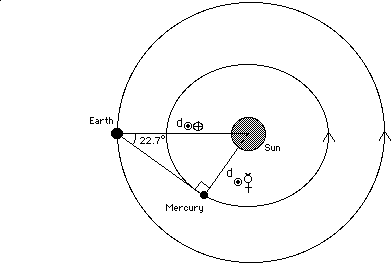
The entire cycle of visibility, called the synodic period takes all of 116 days, almost exactly 1/3rd of our year. In most years, there are three (sometimes part of a fourth) evening appearances of the planet, and three (sometimes part of a fourth) morning shows.
The most recent transit was November 11, 2019. All of it was visible in eastern North America, and central and South America. The US/Canada West Coast missed the beginning. The opposite was true for Europe and Africa and Western Asia. Not visible at all in central and east Asia.
Hope you saw this one; it will be quite a while before there is another....November 2032 to be exact! And that will be on the opposite side of the Earth. The next North American transit viewing will be 2049!
To get some practice observing and measuring Mercury during a transit, there is a lab exercise in Issue 11 of the Classroom Astronomer magazine.
Evening Dates (Gr. Elong. E.) |
Morning Dates (Gr. Elong. W.) |
(Dec. 2021) - January 20 (Jan. 6) |
January 27 - March 8 (Feb. 16) |
| Sets after twilight ends for 11(!) days in January-February [22 -> 3]; no
other apparition this year ever has Mercury appearing in darkness. Greatest brilliancies usually occur
within two days of greatest elongation, except for the April evening and June/July and October morning ones,
when greatest brilliancy is nearly two weeks before (April), nearly a month later (July) and a week later
(October).
|
Not all elongations are created equal. One reason is Mercury has that decidedly elongated orbit. It can be at its greatest elongation point as see from the Earth but if that occurs when Mercury is at perihelion -- closest distance in miles to the Sun -- it will appear much closer (18o)than when Mercury is at aphelion, the farthest point (then it is as much as 27o from the Sun).
Then, there is the fact that, like all planets, Mercury is only found near the Ecliptic, the orbital plane of the Earth in particular, the exact apparent path of the Sun in front of the stars as seen from Earth, and the orbital plane of all planets in general. The Ecliptic is tilted. Sometimes it goes almost straight up from a mid-northern hemisphere horizon. Other times it is close to parallel with the same horizon. When a Mercurial elongation occurs as the ecliptic rises vertically (spring evenings in the northern hemisphere, fall mornings) Mercury is at its best, almost directly above the rising or setting sun. When it is on a horizontal ecliptic, it sets very soon after the sun or rises just minutes before the morning sun, even if it IS far from the solar disk.
Nevertheless it is possible, and a good challenge, to locate Mercury during any of its elongations.
Feb. 28--4oN of Moon
March 2--0.7olower left of Saturn
March 20--1.3oS of Jupiter
April 17--2oR of Uranus!
May 2--1.8oN of Moon
June 27--4oS of Moon
Dec. 24--4oN of Moon
Dec. 28--1.4oabove Venus